Wake Process Of Marine Propeller Disk
Feb 09, 2023
Due to the gradual development of high-speed ships towards large-scale, the changes in the stern structure have a great impact on the wake distribution of the propeller disk. If the traditional high-speed propeller with no sideslip, no longitudinal pitch, and radial pitch distribution is still used, because each revolution is a process of entering and leaving the high and low wake flow field, in this process, the guide edge of the non-side slope type blade almost enters the wake region at the same time, which will increase the induced excitation force on the hull, It brings hidden danger to the safety of the ship. Due to the non-uniform distribution of the wake field at the stern, if the pitch of the different radius layers of the blade is the same, it cannot adapt to the incoming flow speed of the different wake fields, so the propulsion efficiency will be reduced. The pressure distribution on the blade surface and back will be affected by the non-longitudinal inclination distribution. The non-longitudinal inclination reduces the unloading capacity of the blade, reduces the compressive strength of the blade, and thus affects the service life.
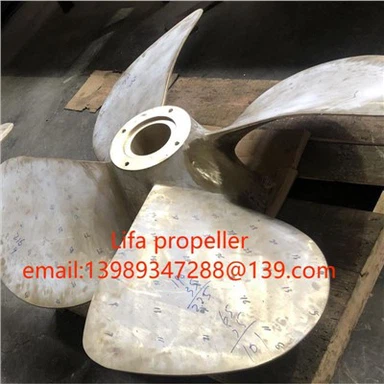
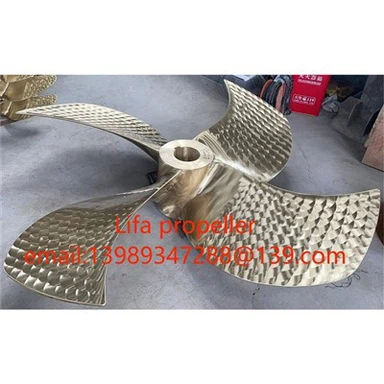
The propeller adopts the radial pitch change pattern of large lateral tilt forward. The large lateral tilt pattern of the blade can ensure that the guide edges of different radius layers enter the high and low wake zones at the same time during the rotation process, and effectively control the excitation force induced by the hull. The distribution pattern of the radial pitch change of the blade can improve the adaptation of the different radial layers of the blade to different incoming flow speeds during the rotation of the blade in the non-uniform wake field at the stern, and improve the propulsion efficiency. The forward tilt distribution can make the stress direction generated by the centrifugal force caused by rotation on the blade section opposite to the stress direction generated by the blade thrust, which can offset the stress generated by a part of the blade thrust on the section, effectively relieve and unload the blade pressure, improve the compression capacity of the blade, improve the strength of the blade, and extend the service life.