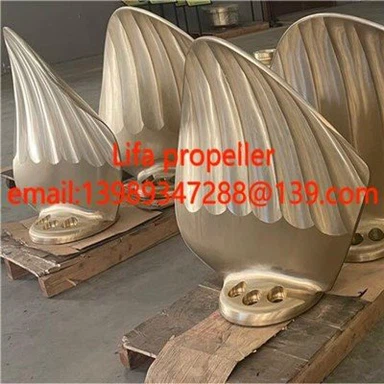
High-speed Ship Propeller VS Low-speed Ship Propeller
Feb 08, 2023
Which is bigger and which is smaller for high-speed ship propellers or low-speed ship propellers?
The principle of a ship's propeller is the same as that of a helicopter's wing, relying on the thrust or lift generated by rotation. The force generated is proportional to the density of the medium, the square of the rotating speed, and the area. In addition, there is a lift coefficient. The density of water is 800 times that of air, so its area can be much smaller than that of helicopters.
Generally, the propellers for high-speed ships are very small, but there will be two or four propellers, but the operation is inconvenient. The larger the ship, the greater the resistance and the greater the thrust required. For some large ships, such as 100000 tonnage oil tankers and bulk carriers, and 300000 tonnage oil tankers, the propeller diameter can reach 4, 5 meters or more.
The huge buoyancy of the water offsets the weight of the ship, so the power requirements of the propeller are correspondingly reduced. In fact, the propellers of large ships are still large, with a diameter of 1-10 meters and a weight of several tons to tens of tons, and the number of propellers of large ships is not one, usually more than two.
For example, the 300000 ton super-large oil tanker is a twin-shaft twin-screw. Each five-blade propeller has a diameter of 10 meters (equivalent to three floors) and a weight of 75 tons.
The difference between large warships and large oil tankers is that warships are used for combat, in order to adapt to the battlefield environment, pursue high speed, carry various weapons and equipment, and occupy a large separation space in the cabin, so the propeller diameter is correspondingly reduced.
The requirements for kinetic energy are different from those of civil ships, so the number of propellers will be increased according to the operational requirements of ships. For example, the US Navy's 100000 ton Nimitz class nuclear-powered aircraft carrier uses four shafts and four propellers, each of which has a diameter of 6.4 meters and weighs 30 tons.