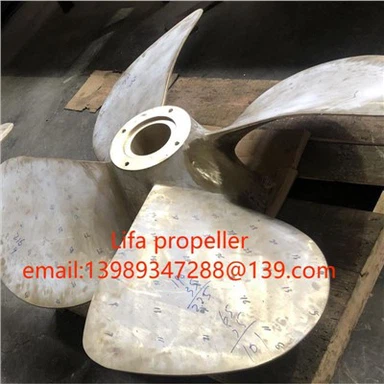
Propeller Is A Powerful Force Bearing Part For Propulsion
Feb 13, 2023
Propeller is a powerful force bearing part for propulsion. The internal strength of large propeller blades is also required. Generally, forging can not be used for forming. At present, the production method that can be used in industry is mainly high-precision casting, which is cast once and then polished mechanically to meet the requirements. Copper has a low melting point and is easy to cast. The hot copper liquid has good fluidity, less bubbles in the casting and high finish, so the propeller material is almost monopolized by copper alloy, and more Z nickel-aluminum bronze is used. It is also possible to use stainless steel casting, but the overall casting technology of stainless steel parts is too difficult.
The melting point of stainless steel is high, so the fire resistance of casting mould should also be improved. There is an empirical formula in industry that the interest will be doubled for every 100 ℃ increase in casting temperature. The melting point of bronze is only 800 degrees, while the melting point of stainless steel is as high as 1700 degrees. The temperature difference is 900 degrees, and the casting interest is 9 times higher. In addition, the costs of precision welding and hard surface polishing are added, and the interest is much more expensive, so the stainless steel propeller is not widely used. Compared with steel materials, copper alloy has its advantages as propeller: low chemical activity, not easy to oxidize, especially nickel-copper alloy, commonly known as white copper, which will not corrode for decades and remain bright as before.
The distance the propeller advances forward guided by the blade angle is called the pitch. In fact, the forward speed of each section on the blade is the same, but the circumferential speed is proportional to the distance (radius) of the section from the shaft, and the propeller rotates one circle. Therefore, the angle between the relative air flow of each section and the rotating plane gradually decreases with the increase of the distance from the rotating shaft. In order to keep the relative air flow of each section of the blade within a favorable range of attack angle, the device angle of each section also decreases with the increase of the distance from the rotating shaft. This is why every blade has a twist. When rotating, the blade pushes a large amount of air (propulsion medium) back from time to time, and a forward force occurs on the blade, namely propulsion force. Generally, the propeller has forward speed in addition to rotation. If a small segment of blade is intercepted, it is just like a small segment of wing, and its relative airflow speed is composed of forward speed and rotation speed. The component of aerodynamic force on the blade in the forward direction constitutes a pull force. The components in the rotating plane form the torque that prevents the propeller from rotating, and are balanced by the torque of the engine. The included angle between the blade section chord (equivalent to the wing chord) and the rotating plane is called the blade installation angle.