

Inspection Record Of Finished Propeller Hub Cap
Jul 14, 2026
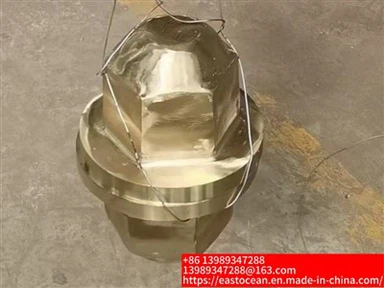
A batch of newly cast marine propeller hub caps have entered the finished product inspection stage. Every testing procedure aims to guarantee operational stability and service life after installation on vessels.
Upon arriving at the inspection station, visual surface inspection is carried out first. Inspectors conduct a comprehensive check over the entire casting surface to detect blowholes, sand holes, cracks, burrs and surface irregularities, ensuring a smooth finish. Rough surfaces will not only increase water resistance during navigation, but also trigger seawater corrosion. This serves as the first essential screening step.

After passing visual inspection, dimensional verification follows. Professional measuring tools are used to measure the thickness of each blade of the hub cap in strict accordance with the tolerance specified on design drawings. The height difference between blades is also measured to ensure uniform positioning of all blades and prevent vibration and noise during operation.

Once dimensional verification is completed, weight inspection is performed. The complete hub cap assembly is weighed with a lifting crane scale, and the actual weight is compared against the theoretical design value. Weight deviation directly affects the dynamic balance performance of the propeller. All recorded data is filed as an important part of factory acceptance documents.
The most critical test, air tightness pressure test, is arranged as the final inspection procedure. Inspection tooling is tightly fitted, connected to a pressure gauge, and pressurized gradually to maintain specified pressure for the required duration. Inspectors continuously monitor gauge readings and carefully check key areas including the main flange and blade roots for leakage. Since hub caps operate immersed in seawater long-term, the air tightness test effectively verifies casting compactness. It prevents seawater ingress and structural corrosion caused by internal porosity, acting as a core test to avoid serious failures in later service.

The complete inspection sequence covers visual screening, dimensional measurement, weight verification and air tightness testing. Products can only be accepted for delivery when all indicators meet technical requirements. East Ocean implements full inspection for all finished products. We control the quality of every marine propulsion equipment with strict standards, and deliver reliable hub caps suitable for vessels operating under complex marine conditions.
You Might Also Like
-
Good Design Aluminum Nickel Bronze Marine Propelle Nut Ma...
-

Lifa Design Fuel-Saving Cu1/Cu3/Cu4 Corrosion-Resistant M...
-

High-Performance Fuel-Saving Marine Hardware Lifa Design ...
-

Marine Hardware Fixed Pitch Fuel-Saving 5%-20% Propeller ...
-
Lifa Design Fuel-Saving Marine Hardware Cu1/Cu3/Cu4 Prope...
-

Marine Lightweight Fixed Windows For Yacht Boat Shipping ...