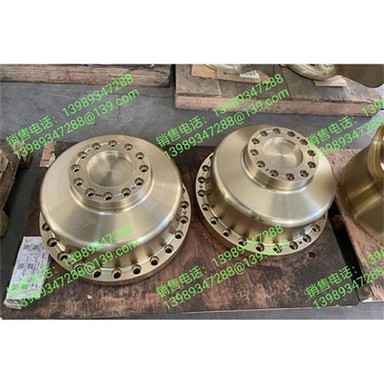
Mechanical processing and manual processing of marine propeller
Feb 18, 2023
1. Marine propeller machining
(1) Remove the risers, gates and other redundant parts at both ends of the propeller hub, resulting in two datum planes with a finish of 5 and an unevenness of less than 0.1mm.
(2) Bore or turn out the shaft hole at the center of the propeller hub, the finish is 25, and the non-perpendicularity is not more than 0.15 mm/M.
(3) Insert the plating groove along the inner side of the shaft hole. Both sides of the keyway should be parallel to the axis of the taper hole. After assembly, the contact surface with the key should not be less than 75%.
(4) The connection between the cone and the keyhole can also be divided into two cases: adhesive and seamless adhesive. With and without keys, the requirements for hub and shaft are different. For bonded epoxy bonding, a 30-70mm long mating surface shall be reserved at the large and small ends of the taper hole. The rest is 0.2~0.3mm lower for grinding and fitting, and there is no cavity in the cone on the shaft. When epoxy bonding is used, the processing requirements and bonding requirements of keys and keyways can be reduced, reducing the workload of grinding and matching.
(5) Formula of epoxy adhesive
Adhesive: epoxy resin (100 parts); Plasticizer (15 parts of dibutyl ester); Filling material (75 parts of plaster powder); Curing agent (6.5~6.6 parts of ethylenediamine)
2. Manual processing of marine propeller
The contents of manual processing include: the surface processing of blade hub, blade and hub, as well as the repair of shaft hole, the elimination of static imbalance, the use of air shovel, grinding wheel, file and other tools.
The steps are as follows: according to the measurement results, draw the processing line, chisel the blade profile in batches, remove the excess metal on the blank, and make the propeller have the required finish.
(1) Processing of leaf surface
When making the blade surface template, generally put all the machining allowance on the back of the blade. It is believed that the blade surface is downward and the casting quality is easy to ensure the surface smoothness, so the blade surface processing is only to eliminate the individual uneven parts of the casting surface, but in most cases, the geometric shape of the blade surface always has a deviation. The task of blade surface processing is to correct the deviation caused by casting. During machining, according to the measurement results of the casting, mark several points on each radial section of the blade where the thickness of the metal layer must be removed, and drill holes at each point where the thickness of the metal layer to be removed is exactly equal to the thickness of the metal layer to be removed. A number of smooth propeller lines are obtained by simply removing the excess metal along the radial section of the blade, and then taking these propeller lines as the benchmark, the blade surface processing can be completed by removing the excess metal along the radial section of the blade.
(2) Blade back processing
The blade back processing takes the blade surface as the reference plane. After the blade surface processing, the blade thickness is re-measured, and the thickness of metal to be removed from the blade back is determined according to the drawing requirements. As for the blade surface processing, first drill holes, remove the shape curve of each section, and then remove the excess metal along the radial direction of the blade.