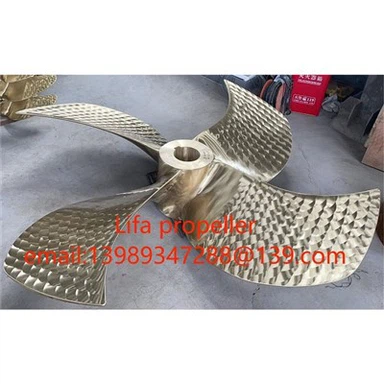
Measures are proposed for the reasons affecting the mechanical performance of the propeller
Jan 19, 2023
1. Strictly control the zinc equivalent and aluminum equivalent to ensure the best chemical composition
When preparing the furnace charge, it is necessary to strictly select the material and prevent some harmful impurities from melting into the alloy liquid. During smelting, zinc equivalent and aluminum equivalent shall be strictly controlled. For brass propellers, the boiling time should be well controlled to prevent the zinc from burning and falling off. The zinc equivalent of ZHMn55-3-1 alloy should be controlled at 42~44%, and that of ZHAl67-5-2-2 alloy should be controlled at 44~46%. Aluminum bronze includes ZQAl2-8-3-2, ZQAl13-7-4-3-1, ZQAl9-4-4-2 and Lloyd's Grade III copper, and the aluminum equivalent should be controlled between 9.5 and 10%. The mechanical performance of the propeller meets the specification requirements.
2. The iron content in the alloy shall be controlled at the average value
Iron is an important element in propeller alloy, too high will lead to poor performance, and too low will not play the role of grain refinement. Therefore, whether it is brass propeller or bronze propeller, it is strictly forbidden to melt pig iron and furnace angle iron into the alloy liquid during smelting. Secondly, when preparing the furnace charge, the selection of iron ingredient is in the middle limit.
3. Strengthen degassing refining and gas content inspection before furnace
Strengthen degassing and refining. For brass alloys, boiling is required to remove chlorine. For bronze alloys, hexachloroethane or nitrogen flushing is required to remove chlorine to remove gas and oxide inclusions in alloy liquid. At the same time, strengthen the inspection of the gas-containing sample in front of the furnace. If the surface shrinkage of the gas-containing sample is not obvious, it cannot be poured, and continue degassing and gas-containing test until it is qualified.
4. Strengthen the bending angle inspection in front of the furnace
The bending angle in front of the furnace is a macroscopic experience assessment method for alloy quality. It has been proved to be effective by production practice. For this reason, the bending angle in front of the furnace shall be inspected for smelting propeller copper alloy, and the fracture shall have flash, slippery crystal band, fine grain and slag inclusion, and the angle shall meet the process requirements.
5. Strengthen the management of furnace charge and strictly inspect the use of old waste
The charge directly affects the mechanical properties of the propeller, especially the "size effect" in the sample, so the charge and melting process should be strictly controlled. For waste, used materials, those without brand and heat number, sampling analysis shall be carried out, and the impurity elements and compounds of used materials shall be quantitatively analyzed to ensure the quality of furnace materials and meet the requirements of mechanical properties of propellers.