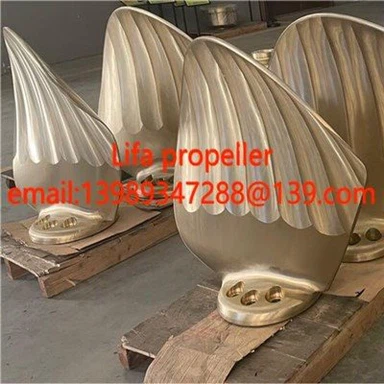
Marine propeller manufacturer tells about the casting process of large copper alloy propeller
Feb 14, 2023
Modeling method
Due to the complex shape of the propeller blade and the large outline size of the super-large propeller, the overall molding technology is particularly critical. Poor molding quality may lead to unqualified casting size and serious casting scrap. Therefore, the modeling process of propeller is particularly important.
At present, the modeling of propeller generally adopts digital pitch gauge, section template, angle line template and manual modeling. The sand mold data is lofted by CAD computer. These data must take into account the deformation law of casting, the shrinkage characteristics of alloy, and appropriate machining allowance. After the sand mold is made, the section template and angle line template and other test templates are used to recheck the blade size to ensure that the data meet the requirements.
Determination of shrinkage
The blade of the propeller is wide and the distribution of blade thickness is uneven. The larger thickness of the heel is 336 mm, and the blade tip is only 22 mm. The gap is so large that the pouring temperature and cooling speed of the casting are different. The casting shrinkage deformation is serious and the deformation is different. The factors and rules affecting the deformation are not completely clear. The guide edge is concave downward, and the blade is twisted upward with the edge, and the pitch becomes smaller. Therefore, it is specified in the process that the shrinkage of (0.2~0.4) R pitch line is 1.0%, (0.5~0.7) R pitch line is 2.0%, and (0.8~1.0) R pitch line is 3.0%; The overall linear shrinkage is 1.5%.
Determination of processing quantity
In order to reduce the surface defects of castings and obtain castings with qualified size and good surface quality, the requirements cannot be met only by the consideration of shrinkage and deformation, and the machining allowance must be properly added. The machining allowance of the blade is determined as follows: the machining allowance is not allowed on the blade surface; No machining allowance is allowed on the blade surface; See Figure 1 for machining allowance of blade back; The machining allowance of guide edge and trailing edge is 20mm; The outer circle of the propeller hub is 10mm on one side, the machining allowance of the inner hole of the propeller hub is 15mm on one side, the large end of the propeller hub is 15mm longer, and the small end is 10mm longer.
Determination of pouring and riser
Because the material of propeller ZCuAl9Fe4Ni4Mn2 contains a lot of Al, it is very easy to form secondary oxidation slag during the pouring process. Therefore, when designing the gating system, it should consider whether the gating system can ensure the smooth filling of molten metal, and should have a reasonable pouring speed, slag blocking and slag removal capacity to prevent turbulence. Generally, the bottom pouring type is used, and the section ratio of the general gating system is straight: horizontal: internal=1: (2~2.5): (10~30). Because the gross weight of the casting is large, two pieces are used φ 26 60 mm sprues φ 60mm internal runner.
The overall shrinkage of copper alloy propeller is about 1.5%, so the riser design is also very important. Generally, the riser height is 0.6~0.8 times of the hub height.
Drying and cooling
The hot air blower is used to dry the mold, which is mainly to reduce the moisture in the molding sand and reduce the defects such as pores, oxidation slag inclusion and so on during the pouring process due to the high moisture content of the molding sand. In order to bake the mold evenly, the air outlet at the blade tip is opened at the lower point of the blade trailing edge, and the mold is kept at 150 ℃ for about 24 hours to ensure that the air outlet temperature is not lower than 40 ℃.
Due to the large thickness gradient of the blade, the cooling time of each part will be different. In order to ensure that the casting has sufficient strength, the heat preservation of the casting shall not be less than 120h after pouring. When the temperature drops to 300 ℃, the box shall be opened. By extending the cooling time, the casting stress can be fully released to prevent blade deformation due to large temperature gradient.