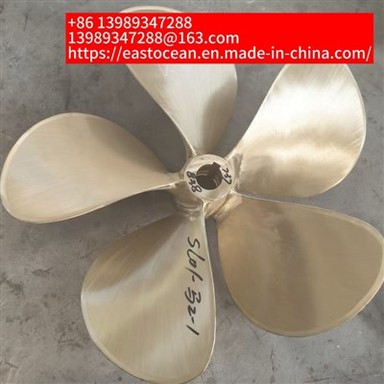
Test Method For Static Balance Of Marine Propellers
Feb 16, 2023
When the accuracy deviation of the static balancing device itself exceeds 1/3m, the hanging weight method is used. After releasing from the horizontal position, each hanging weight blade can naturally turn down to the same position close to the Z low point, and then measure the hanging weight guard (m1, m2, m3......) value at the blade end. When (mmax-mmin<=m), it is considered qualified. Generally, it can be divided into arbitrary balance method and hanging weight method.
Place it on the balance frame, hang the weight m1 and m2 on the blade tip of the adjacent blade separately, adjust it to make it balanced, and then slowly rotate it to slowly stay at any position without obvious rotation, and then weigh the Z large hanging weight mmax, which shall not exceed the allowable unbalance value, and it is qualified.
The accuracy deviation of the calibration static balance test device itself shall not be greater than 1/3 of the allowable unbalance value. Its accuracy depends on the friction force of the journal on the support. The greater the friction force, the rougher it will be. Generally, small propellers should be statically balanced on the cylinder or on the track. When large propellers use the cylinder, the journal will be easily worn due to excessive pressure. Generally, the roller bearing diagram is commonly used.