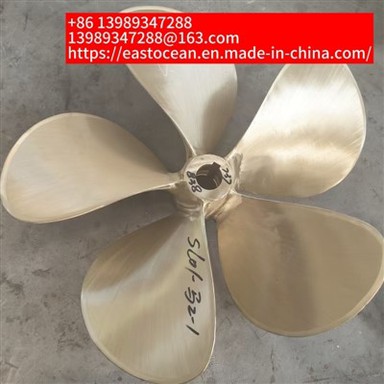
3 Blades Marine Propeller
- Fast Delievery
- Quality Assurance
- 24/7 Customer Service
Product Introduction
What is 3 Blades Propeller
A Marine 3-blade propeller is a type of propeller used in marine vessels, typically boats and ships. As the name suggests, it has three blades, which rotate around a central hub to generate thrust and propel the vessel forward or backward through the water. The design of the propeller is based on the principle of the screw, which means that it pushes water backwards to propel the vessel forward. The size and shape of the blades can vary depending on the specific requirements of the vessel, such as its size, power output, and intended use. Marine 3-blade propellers are commonly used in recreational boats, commercial vessels, and military ships.
Advantages of 3 Blades Propeller
Better Acceleration: A 3-blade propeller provides quicker acceleration as it generates more thrust per rotation than a 2-blade propeller.
Smooth Operation: A 3-blade propeller offers smoother operation since it creates less vibration than a 2-blade propeller.
Wide Range of Applications: 3-blade propellers are versatile and are suitable for a wide range of applications, from pleasure boating to commercial shipping.
Fuel Efficiency: A 3-blade propeller can improve fuel efficiency as it generates more lift per rotation and can reduce the use of power needed to maintain a certain speed.
Better Steering: A 3-blade propeller offers improved steering control and handling due to the increased thrust and the way the blades cut through the water.
Durability: 3-blade propellers are generally more durable due to the increased number of blades, which reduces the stress on individual blades.
Lower Noise and Vibration: The additional blade on a 3-blade propeller reduces noise and vibration, making it a better choice for pleasure boats where a quieter ride is desired.
Easy Maintenance: 3-blade propellers are easier to maintain since they typically have fewer moving parts and require less maintenance than other types of propellers.


Why choose us
Quality: Lifa Propeller is a highly trusted and reliable brand within the propeller industry. They take pride in their quality products and ensure that all of their propellers are made with high-quality materials and engineering.
Innovation: Lifa Propeller is continuously innovating and developing new technologies to improve the performance of their products. This makes them the top choice for anyone looking for the latest propeller designs and technologies.
Expertise: With over 50 years of experience in the propeller industry, Lifa Propeller has established themselves as experts in their field. Their team of professionals has the knowledge and experience to provide the best advice and support to their customers.
Customization: Lifa Propeller offers customized propeller solutions to meet the specific needs of their customers. They understand that different boats and applications require different propellers, and they work closely with their customers to find the perfect solution.
Customer Support: Lifa Propeller has an excellent customer support team that is always ready to assist their customers with any questions or concerns they may have. They are committed to providing top-notch customer service and ensuring customer satisfaction.
The 4-Blade Vs 3-Blade Prop - What's The Difference
The most asked question at the boat shows is almost always "what is the difference between a 3-blade and a 4-blade boat propeller?" The difference between a 3-blade prop vs a 4-blade prop is that the 3-blade (smaller blade ratio) is faster with a higher top speed and the 4-blade (higher blade ratio) has a better hole-shot (acceleration) and better stern lift as well as better handling and fuel economy because it will keep you on plane at a lower speed.
If you look at a propeller from behind, and visualize a circle that the blade tips would draw, you will see that the blade of a 3 blade prop covers about 50 -55% of the circle. (This is called diameter area ratio or DAR). You can add thrust within this drive circle by increasing that percent (to say 60 - 65%) by adding a 4th blade. When you look at a four blade prop you will notice that more of this area is covered because of the extra blade. That means more push contact with the water.
4-Blade vs 3-Blade prop
Many other factors including how you will be using your boat can affect your choice of prop. The propeller experts at can help you find the right 3 or 4-blade Propeller.
Boat Propeller Cavitation Vs Ventilation
Have you ever run your finger along the face, or edge, of a prop and felt a pitted area? If you have, then you know what cavitation can do to a prop. Given enough use, that pitting will only get deeper and you will have to replace the prop.
With your prop turning 4000 RPMs how do you know if you have power-robbing and prop-damaging cavitation.

What is Prop Cavitation
Cavitation very commonly occurs on damaged, or imperfect, propellers and can occur if an attempt is made to transmit too much power through the prop. At high rotating speeds or under heavy load (with high blade lift coefficient), the pressure on the inlet side of the blade can drop below the vapor pressure of the water, resulting in the formation of a pocket of vapor, which can no longer effectively transfer force to the water.
What Causes Cavitation
The true cause of cavitation can arise from several factors, but we see them occur most often as a result of leading-edge imperfections, such as nicks, dings, scratches, bends, etc. They can also be caused by improper geometry or upstream imperfections related to the hull, such as hull design and configuration, hull imperfection, incorrectly installed accessories/appendages, etc. Since there are so many possible causes, diagnosing the problem should really be done on a per case basis.
Cavitation wastes energy and makes the propeller "noisy" as the vapor bubbles collapse, and most seriously, erodes the prop's surface due to localized shock waves against the blade surface.

2, 3 and 4 Blade Propellers are They All the Same
I am always asked why should I have a 2, 3, or 4 blade propeller on my boat. The answer truly comes down to how you use the boat
Three Blade
If you use your boat for cruising, or if you have to power in to a current every time you go out a 3 or 4 blade is the better choice. They have a major advantage when going against heavy winds and seas or a current as they will keep your boat speed by up to 30% better than the two blade. Moreover, they will run much smoother and reduce vibrations as it is balanced around 3 or 4 points as opposed to 2.


Four Blade
A 4 blade is a great choice if the vessel is heavy for its length the increased blade area will power the boat more efficiently. Or there is a limitation in the size of propeller the vessel will fit a 4 blade will allow for a more efficient pitch. Also fast shaft Rpm, if the shaft rotates at above 1500 rpm the 4 blade will smooth out annoying vibrations. Another reason for installing a 4 blade is when the vessel has limited horsepower. For example a 50' boat with a 75 horsepower engine, the 4 blade will have the much needed blade area to keep the vessel powering into heavy wind an seas.
3-Blade or 4-Blade Props: Which is Best
Three-blade props offer a pleasing compromise when it comes acceleration, efficiency, lift and speed, but a four-blade propeller might enable faster acceleration, or greater.
Most outboard motors - 90 percent by some estimates - use three-blade propellers, and they offer strong performance for most boating applications. Yet, can boating anglers expect better performance from a four-blade prop? The answer is yes .
Four-blade props can improve fuel efficiency for greater fishing range.can enhance lift, a critical performance characteristic for boats that fish in shallow water. Three-blade propellers are popular because they tend to offer a performance compromise, a pleasing (or at least satisfactory) blend of acceleration, fuel efficiency, lift and speed,
Ventilation Issues
Ventilation - the tendency of the blades to lose their "bite" - often occurs when props are immersed in aerated water, such as the wake of a stepped-hull boat. On other boats, aeration might occur as a result of poorly positioned water intakes or large through-hull transducers.
A four-blade is less likely to ventilate in aerated water, simply because it has more blades to grab the water. That's why you see some stepped hulls equipped with these props.
Four-blades can resolve other ventilation issues. For example, if the jack plate on a bay boat is too high, the prop tends to lose its bite and ventilates. The grip of a four-blade allows a bay-boat captain to maximize the height of the outboard, and cross flats that might not be navigable with a three-blade prop.
Prop Bite: How Many Prop Blades Do You Need


Three-, four- and five-blade props deliver different performance characteristics that might be right for your boat.
When considering propellers, many boat owners get fixated on speed. They assume a prop that will make their boat go faster must be better. It's more important to consider how a propeller can impact the entire boating experience. Speed is one element of that experience, but so are acceleration, economy, comfort and boat handling. Which is one reason Mercury Marine offers a wide range of propellers, including models with three blades, four blades and even five blades. Each design is intended to enhance overall performance in certain applications to make a boat work its best on the water.
Let's look at how the number of blades affects propeller performance.
Three Blades
Technically, a propeller with a single blade would be the most-efficient design simply because it would produce the least drag in the water. But with a single blade winging around at speed, the vibration would be intolerable. A propeller with three blades achieves the best balance of smooth operation and minimal drag through the water, which is why a three-blade design is the most popular for general boating.
Within that three-blade design, engineers can manipulate blade area, blade rake and cupping to build a prop that can perform well in a specific application - for instance, lifting the bow of a performance boat for more speed or lifting the stern of a heavy cruiser on plane. The three-blade propeller is one of the company's most popular props and a great example of a premium three-blade model. It offers outstanding performance on lighter bass, bay and flats boats running high-horsepower outboards.
Four Blades
Adding a blade further reduces vibration, and usually adds blade area to a propeller design. Increasing blade area can improve hole-shot acceleration and increase lift at the stern. That fourth blade also adds some drag, which might reduce top speed.
Five Blades
Adding a fifth blade further increases blade area, reduces vibration and improves the prop's ability to hold its grip on the water. The Five prop is designed for use with outboards and sterndrives by boaters seeking outstanding hole-shot acceleration for tow sports, who don't mind giving up some top speed to get that performance. The five-blade propeller is designed to be paired with sterndrives mated to big-block engines, especially on performance boats with a high drive height. Placing the drive higher on the transom reduces drag and can increase speed, but it also places the propeller near the surface. The five-blade design of the allows it to maintain a solid bite on the water, even in the highly aerated water flow produced by performance boats with stepped hulls.
Certificate

FAQ
Q: Why use a 3 blade propeller?
Q: What is better a 4 blade prop or a 3 blade prop on a boat?
Q: Is a 3 blade prop better than 2 boat?
They have a major advantage when going against heavy winds and seas or a current as they will keep your boat speed by up to 30% better than the two blade. Moreover, they will run much smoother and reduce vibrations as it is balanced around 3 or 4 points as opposed to 2.
Q: What are the applications of propeller?
Propellers are used to pump fluid through a pipe or duct, or to create thrust to propel a boat through water or an aircraft through air.
Q: What are the disadvantages of a 3-blade prop?
Q: What is the advantage of a 4 blade prop over a 3-blade prop?
Q: What is the disadvantage of a 4 blade prop?
Q: Can I replace my 3 blade prop with 4 blade?
Q: Do you lose speed with a 4 blade prop?
Q: What is the most efficient boat propeller design?
Q: What prop makes a boat go faster?
Q: What is the most common propeller?
Q: What is the best number of blades for a propeller?
A propeller with three blades achieves the best balance of smooth operation and minimal drag through the water, which is why a three-blade design is the most popular for general boating.
Q: What is the most efficient propeller blade?
Q: What is the most efficient propeller blade shape?
Q: What pitch prop is best for speed?
Q: What pitch is best for my boat?
Q: What prop will make my pontoon faster?
Q: Is there a difference in RPM between 3 blade and 4 blade prop?
Q: Is a stainless steel prop worth it?
Hot Tags: 3 Blades Marine Propeller, China 3 Blades Marine Propeller manufacturers, suppliers, factory