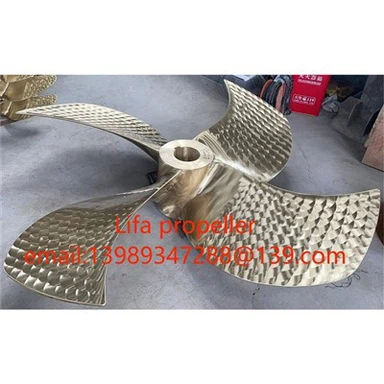
What should we pay attention to when welding propeller marine booster?
Feb 03, 2023
1. Cracks and broken blades shall be welded in an appropriate way. For the broken blades in Zone C, when selecting the newly made block for connection welding, it is necessary to obtain the approval of the surveyor for the organic chemical composition B and physical performance test report of the newly cast and welded block. During welding, the working pressure of the blade should be facing down, the lower edge of the professional butt joint should be padded with a liner plate, and the welded junction should be U-shaped or V-shaped on both sides, and should be welded thoroughly. Welding shall be carried out from the management center to both sides along the direction.
2. During welding, corresponding measures shall be taken to reduce the welding temperature, and the interpass temperature at the bath shall be maintained at 300 ℃ to reduce zinc volatilization and air oxidation. During welding, the butt weld meat shall be continuously hammered in a concentrated and uniform manner to widen it and reduce the amount of crater closure, so as to ensure that cracks are not easily caused between the weld meat and the original material again.
3. After repair welding, the aircraft propeller shall be subject to annealing treatment. For area A, B or other large-scale repair welding, if allowed by the standard, it shall be heated at a rate of not more than 100 ℃ per hour to the quenching temperature. The insulation and heat preservation time of the whole propeller shall be 4~8 hours according to the size of the propeller, and the temperature reduction rate shall not exceed 55 ℃ per hour. After the temperature is reduced to below 200 ℃, the furnace can be opened for cooling.
4. If it is a blade or part of the blade after repair welding, if there is no furnace quenching standard, the heat insulation and heat preservation time can be calculated as 20 min/25 mm at the thin thickness of the larger cross section of the repair welding position, but not less than 1 hour, and then the binding is carried out with heat preservation materials, accompanied by the automatic reduction of the indoor temperature, and the annealing treatment is carried out. After quenching, polish and polish the welding surface, and conduct color flaw detection to check whether there are cracks, blowholes, weld beading, looseness and other conditions.