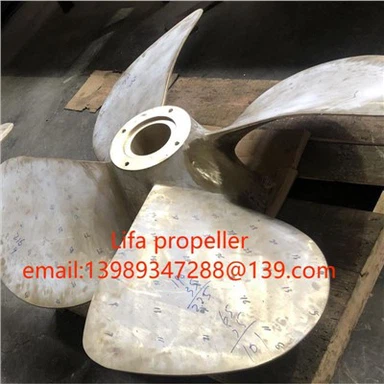
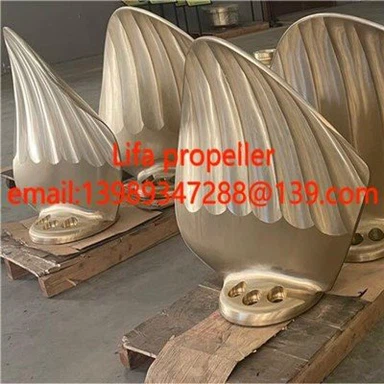
In order to ensure the safe navigation of ships, high-quality marine propellers should be used
Feb 01, 2023
In order to ensure the safe navigation of ships, high-quality marine propellers should be used, because marine propellers, also known as propellers, are important castings of ship power devices and important equipment to ensure the safe navigation of ships. Propeller operates in seawater and bears huge alternating load, which requires high mechanical property, high corrosion fatigue resistance, excellent cavitation corrosion resistance, and casting defects such as blowholes and slag inclusions are not allowed. The common propeller is made of copper alloy, which is mainly used for the manufacture of large and high-speed ships. Its main advantages are light weight and high strength. The fatigue resistance and cavitation erosion resistance are good, but the disadvantage is that the casting and processing requirements are high. If the corresponding process measures are not adopted during welding, problems such as difficult fusion, air holes, hot cracks, and low-level welding deformation of joint performance will occur. The following describes the use of argon arc welding to repair the slag inclusion defects of the propeller.
Defect description
The crystallization range of copper alloy is narrow and the volume shrinkage is large. In addition, the alloy also contains active elements such as Al, Mn, Fe, Ni with strong affinity for oxygen. During the pouring process, high temperature copper water enters the propeller cement sand mold and gating system which is not fully dried, and a large amount of adsorbed water-based crystalline water on the surface of the mold precipitates rapidly into water vapor. When the water vapor interacts with the alloy elements, the oxidation slag will be generated. Most of the defects appear at the lower 0.5R-0.8R trailing edge of the blade surface; Another reason is that during the pouring process, the oxide film covering the entire surface of the molten copper plays a protective role, and the surface area continues to expand after the molten copper enters the blade. However, when the copper liquid rises to the Z height of the propeller mold, i.e. 0.3R-0.5R guide edge, due to the large reduction of the horizontal section of the propeller blade and the change of the copper liquid flow direction to the upper part of the propeller shell and the riser, a large amount of secondary oxidation slag is accumulated and the removal resistance increases, resulting in a sharp increase in the amount of secondary oxidation slag in this area.
Selection of welding materials
The welding material shall be selected according to the material of propeller with similar performance.
Preparation before welding
Grind the defects with a sander and completely remove the defects until the intact parent material appears. The appropriate welding groove shall be processed, and the groove shall be smooth and free of burrs. Then use acetone, steel brush, etc. to clean the welding repair parts and other magazines such as oil, oxide, moisture within 20mm of both sides. The welding rod shall be dried at 200 ℃ and kept for 1-2 hours.
Due to the high thermal conductivity of copper, the heat is easily lost during welding, so preheating must be carried out before welding. On the other hand, preheating can also improve the welding stress distribution and reduce the risk of stress corrosion cracking. The preheating temperature shall not be less than 150 ℃. The flame gun or electric heating belt can be used for preheating. The interpass temperature shall not exceed 300 ℃ and shall be maintained until the end of welding repair. The preheating range shall not be less than 100 mm from each direction of the welding repair area.
Welding parameters and operation
The argon arc welding is adopted for repairing the propeller defects in our factory, and the alternating current is adopted. The diameter of welding wire is 7mm.
Post weld treatment
Because copper alloys are sensitive to stress corrosion, stress relief heat treatment must be performed after welding. For very small weld repairs, soft fire gas distance or electric wire heater can be used for local stress relief treatment, and the weld repair can be locally heated to the annealing temperature. The minutes of heat preservation shall be greater than the number of millimeters of the section thickness at this place, and then the asbestos cloth shall be used to cover the slow cooling. After the post-weld heat treatment is completely cooled, dye penetrant inspection shall be carried out until no cracks, pores and other defects are found in the inspection results, and the quality can meet the requirements. Otherwise, repair welding shall be carried out. Finally, static balance test, correction, pitch measurement, thickness measurement, polishing and polishing.